
Table of Contents
What Makes an E-Signature Legally Binding?
Electronic signatures are used in millions of transactions every day — from real estate closings to freelance contracts to employee onboarding paperwork. But a common question persists: are they actually legal?
The short answer is yes. E-signatures carry the same legal weight as handwritten signatures in the United States and most countries worldwide. However, there are specific requirements that must be met. Understanding these requirements protects you and your business.
The Two Laws That Govern E-Signatures in the U.S.
The ESIGN Act (2000)
The Electronic Signatures in Global and National Commerce Act, commonly known as the ESIGN Act, is a federal law passed in 2000. It establishes that electronic signatures and electronic records cannot be denied legal effect solely because they are in electronic form.
In practical terms, the ESIGN Act means:
- A contract cannot be thrown out in court just because it was signed electronically.
- Electronic records satisfy any legal requirement that a contract be "in writing."
- Both parties must consent to conducting business electronically.
UETA — Uniform Electronic Transactions Act
UETA is a state-level law adopted by 49 U.S. states (New York has its own equivalent legislation). It complements the ESIGN Act and provides additional guidelines:
- An electronic signature is attributable to a person if it was the act of that person.
- An electronic record satisfies any law requiring a record to be in writing.
- The effect of an electronic signature is determined from the context and surrounding circumstances.
Together, these two laws form the legal backbone of e-signatures in the United States.
Five Requirements for a Legally Binding E-Signature
While the law broadly supports electronic signatures, courts look for specific elements when determining enforceability:
1. Intent to Sign
The signer must clearly demonstrate their intention to sign the document. This is no different from a wet-ink signature — accidentally dragging your pen across a page doesn't constitute a signature.
In the digital context, intent is typically demonstrated through deliberate actions like clicking a "Sign" button, drawing a signature with a mouse or finger, or typing a name into a designated signature field.
2. Consent to Do Business Electronically
Both parties must agree to conduct the transaction electronically. This consent can be explicit (a checkbox or a click-through agreement) or implied through the parties' conduct.
For example, if a client opens an email, clicks a link to review a document, and then applies their signature — that sequence of actions demonstrates consent to the electronic process.
3. Clear Signature Attribution
It must be possible to identify who signed the document and to associate that person with the signature. This is where a good e-signature platform becomes essential.
Attribution is typically established through:
- Email verification: The document was sent to a specific email address, and the signer accessed it through that email.
- IP address logging: The signing event records the signer's IP address.
- Timestamps: Precise date and time of the signing event.
- Authentication: Multi-factor authentication or access codes add an extra layer of identity verification.
4. Association of Signature with the Record
The signature must be connected to the specific document being signed. A standalone signature file without context has limited legal value. The e-signature must be logically associated with the full content of the agreement.
This means the signed document should be a complete, tamper-evident record that shows exactly what the signer agreed to at the time of signing.
5. Record Retention
The signed document must be stored in a way that is accurate and accessible for future reference. Both parties should be able to access and reproduce the signed record.
Under the ESIGN Act, if a law requires a document to be retained, that requirement is satisfied by an electronic record that accurately reflects the information in the contract and remains accessible to all parties.
The Role of Audit Trails
An audit trail is arguably the most important technical component of a legally binding e-signature. A comprehensive audit trail records:
- Who signed the document (name, email address)
- When they signed (precise timestamp, often in UTC)
- Where they signed from (IP address, device information)
- What they signed (a hash of the document to prove it hasn't been altered)
- How they authenticated (email link, access code, two-factor authentication)
If a signature is ever challenged in court, the audit trail serves as the primary evidence of the transaction's legitimacy. Without it, proving intent, consent, and attribution becomes significantly harder.
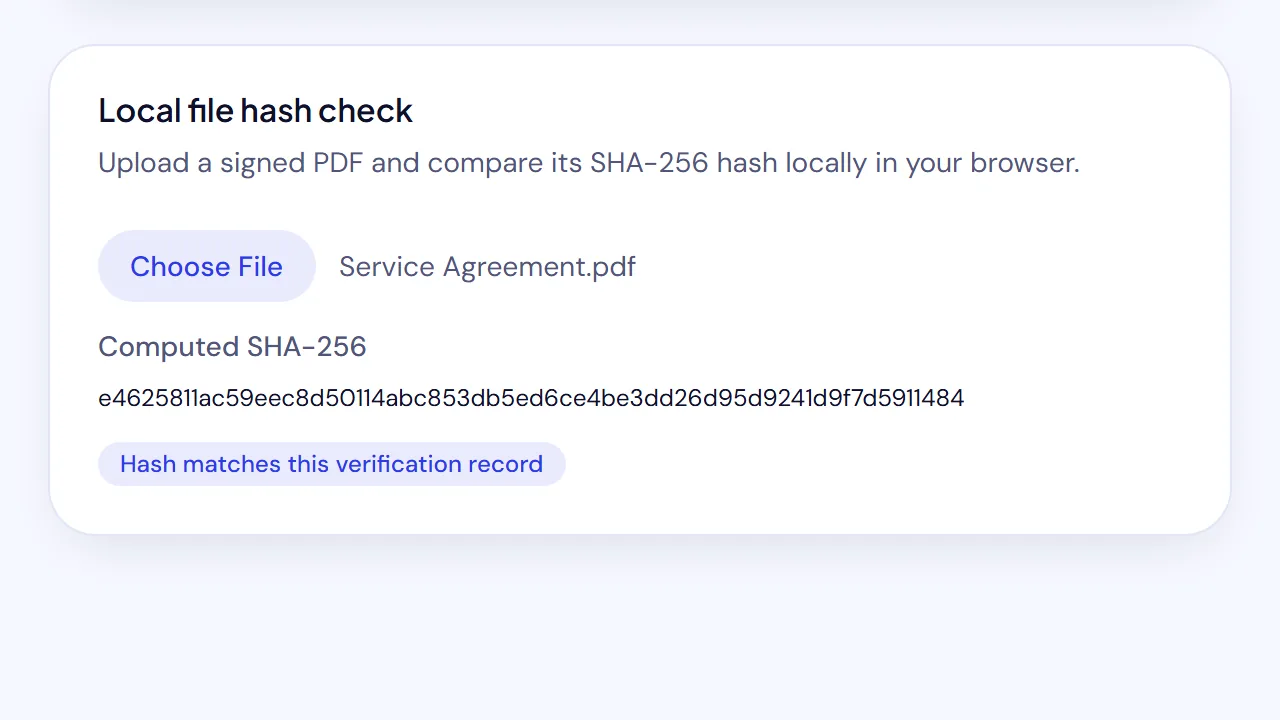
This is why choosing an e-signature platform with robust audit trail capabilities matters. Every signing event — from document creation to final completion — should be logged in a tamper-evident record. In SignQuick, the help center shows how to download the audit trail and verify a signed PDF.
What Types of Documents Can Be E-Signed?
Most business documents can be legally signed electronically, including:
- Contracts and agreements (service agreements, NDAs, SOWs)
- Real estate documents (purchase agreements, leases, disclosures)
- HR paperwork (offer letters, employee handbooks, policy acknowledgments)
- Financial documents (loan applications, insurance forms)
- Sales documents (proposals, purchase orders, invoices)
Exceptions
Certain documents are excluded from the ESIGN Act and generally require wet-ink signatures:
- Wills and testamentary trusts
- Family law documents (adoption, divorce agreements) in some jurisdictions
- Court orders and notices
- Notices of cancellation of utility services or health/life insurance
- Documents accompanying hazardous materials transport
For the vast majority of business transactions, e-signatures are fully valid and enforceable.
International Validity
E-signature laws vary by country, but the trend is global acceptance:
- European Union: The eIDAS regulation establishes three levels of e-signatures (simple, advanced, and qualified). Simple e-signatures are legally admissible, while qualified e-signatures have the highest legal standing.
- United Kingdom: The Electronic Communications Act 2000 recognizes e-signatures, and post-Brexit, UK courts continue to uphold their validity.
- Canada: PIPEDA and provincial laws recognize electronic signatures for most commercial transactions.
- Australia: The Electronic Transactions Act 1999 provides legal recognition for e-signatures.
If you conduct business internationally, verify the specific requirements of each jurisdiction — but the broad principle holds: e-signatures are legally recognized in most developed economies.
Best Practices for Maximum Legal Protection
- Use a platform with comprehensive audit trails. Every signing event should be logged with timestamps, IP addresses, and document hashes.
- Require email-based access. Sending documents to verified email addresses creates a clear chain of attribution.
- Add a verification code for sensitive documents. Requiring an emailed verification code before the signer can open the document creates an additional layer of identity verification on top of the secure link.
- Retain signed documents securely. Ensure both parties can access the signed record at any time.
- Include a consent clause. A brief statement that the signer agrees to sign electronically removes any ambiguity about consent.
Getting Started
If you're looking for an e-signature platform that handles all of these legal requirements out of the box — audit trails, email verification, secure storage, and tamper-evident records — SignQuick offers a free tier to get started. Every document signed on SignQuick includes an audit trail and 256-bit encryption, so your signatures are legally defensible from day one.
Ready to send your first document? Start free with SignQuick →

