
Table of Contents
Free NDA Template for Freelancers and Small Businesses
To use this free NDA template, choose whether the agreement is mutual or one-way, replace every bracketed field, delete options that do not fit, review the final text with the other party, and export the agreed version as a PDF for signature.
The template below is a balanced mutual non-disclosure agreement for a freelancer and client or two small businesses. It is a general starting point, not legal advice or a promise that the agreement fits your location or facts.
Do you need a separate NDA?
Use a separate NDA when confidential information must be shared before a services agreement is ready or when the existing contract has no suitable confidentiality terms. If a signed services agreement already covers the same information, people, purpose, and time period, a second document may add conflicts instead of protection.
| Situation | Better starting point |
|---|---|
| Only the client will share non-public information | One-way NDA naming the client as the Disclosing Party |
| Only the freelancer will share a private method, proposal, or business information | One-way NDA naming the freelancer as the Disclosing Party |
| Both sides will share sensitive information | Mutual NDA |
| You need terms for scope, payment, deliverables, or ownership | A services agreement, not just an NDA |
| The work involves regulated personal, health, payment, or financial data | Specialized legal and security review in addition to an NDA |
| No meaningful confidential information will be shared | Skip the NDA |
An NDA does not make every idea a trade secret, transfer copyright, prove independent-contractor status, or replace practical security controls.
Should the NDA be mutual or one-way?
The copyable template is mutual: either party can disclose information, and the same rules apply to both. That often fits freelance discovery calls, agency partnerships, joint proposals, and vendor evaluations.
To make it one-way, identify only one party as the Disclosing Party and the other as the Receiving Party. Replace reciprocal phrases such as “each Party” with the correct role throughout. Do not leave the choice ambiguous in the signed version.
Free NDA template to copy and paste
Mutual Non-Disclosure Agreement
This Mutual Non-Disclosure Agreement (“Agreement”) is effective as of [EFFECTIVE DATE] between:
- Party A: [FULL LEGAL NAME], located at [ADDRESS]
- Party B: [FULL LEGAL NAME], located at [ADDRESS]
Each may disclose Confidential Information as a Disclosing Party and receive it as a Receiving Party. Together they are the Parties.
1. Purpose
The Parties may share Confidential Information only to evaluate, discuss, or perform [DESCRIBE THE PROJECT, SERVICE, OR BUSINESS PURPOSE] (“Purpose”).
2. Confidential Information
“Confidential Information” means non-public business, technical, financial, customer, product, security, or project information disclosed for the Purpose that is marked confidential or that a reasonable person would understand to be confidential from its nature or the circumstances.
Examples may include [LIST RELEVANT EXAMPLES, SUCH AS SOURCE CODE, CREDENTIALS, CUSTOMER LISTS, PRICING, FINANCIAL DATA, PRODUCT PLANS, RESEARCH, DESIGNS, OR UNRELEASED WORK].
Oral or visual information is covered only if the Disclosing Party identifies it as confidential when disclosed and summarizes it in writing within [NUMBER] days.
3. Exclusions
Confidential Information does not include information the Receiving Party can show:
- became public without a breach of this Agreement;
- was lawfully known without a confidentiality duty before disclosure;
- was received lawfully from a third party allowed to disclose it; or
- was developed independently without using the Confidential Information.
4. Use and protection
The Receiving Party will:
- use Confidential Information only for the Purpose;
- share it only with personnel, professional advisers, or approved subcontractors who need it for the Purpose and are bound by suitable confidentiality duties;
- protect it with at least reasonable care and no less care than the Receiving Party uses for its own similar information;
- copy, store, and access it only as reasonably needed for the Purpose; and
- promptly notify the Disclosing Party of suspected unauthorized access, use, or disclosure.
5. Required and protected disclosures
If law or a valid legal process requires disclosure, the Receiving Party may disclose only what is required and, when legally permitted, will give prompt notice so the Disclosing Party may seek confidential treatment.
Nothing in this Agreement prohibits reporting a suspected violation of law to a government authority or making another disclosure protected by applicable law.
6. Return or deletion
At the Disclosing Party’s written request or when the Purpose ends, the Receiving Party will return or delete Confidential Information within [NUMBER] days and, if requested, confirm completion in writing.
The Receiving Party may retain information required by law or contained in routine backups that cannot reasonably be isolated, but any retained information remains subject to this Agreement.
7. Ownership and no license
Each Disclosing Party keeps ownership of its Confidential Information. This Agreement grants no license or ownership right except the limited right to use Confidential Information for the Purpose.
This Agreement does not transfer ownership of deliverables or work product and does not require either Party to start or continue a project. Those terms belong in a separate services agreement or statement of work.
8. Term
This Agreement begins on the Effective Date and continues for [NUMBER] [MONTHS / YEARS].
The confidentiality and use obligations for each disclosure continue for [NUMBER] [MONTHS / YEARS] after that disclosure. Information that qualifies for different or longer protection under applicable law remains protected only to the extent and for the period that law permits.
9. Other agreements
This Agreement covers confidentiality for the Purpose. If another agreement between the Parties addresses the same information, the Parties will state which provision controls: [IDENTIFY THE CONTROLLING DOCUMENT OR RULE].
10. General terms
This Agreement is governed by the laws of [STATE / PROVINCE / COUNTRY]. The Parties will resolve disputes in [COURT, ARBITRATION, MEDIATION, LOCATION, OR OTHER AGREED PROCESS].
This Agreement contains the complete understanding about confidentiality for the Purpose. Any amendment must be in writing and accepted by both Parties. If one provision is unenforceable, the remaining provisions continue to the extent permitted by law.
The Parties may sign counterparts and use electronic signatures to the extent permitted by applicable law.
Signatures
Party A- Legal name: [LEGAL NAME]
- Signer name and title: [NAME AND TITLE]
- Signature: ______________________________
- Date: [DATE]
- Legal name: [LEGAL NAME]
- Signer name and title: [NAME AND TITLE]
- Signature: ______________________________
- Date: [DATE]
How to customize the NDA
Do not send the template with vague fields or competing options. Before signing:
- Define one real purpose. “Discussing possible work” is clearer when it names the project, evaluation, or service.
- List the sensitive categories. Avoid saying that everything is confidential without explaining what the Parties expect to protect.
- Name permitted people and tools. Decide whether subcontractors, cloud storage, code assistants, or AI tools may receive the information.
- Choose mutual or one-way language. Read every clause again after changing roles.
- Set realistic time periods. Match the duration to the information and applicable law instead of copying a number from another contract.
- Choose governing law and a dispute process. Do not leave those placeholders in the signed PDF.
- Compare related contracts. The NDA, proposal, services agreement, privacy terms, and statement of work should not contradict one another.
The free freelance contract template covers scope, payment, revisions, ownership, and termination. Use it separately when the project needs commercial terms.
What needs legal review before you sign?
An NDA is highly dependent on the people, information, and jurisdiction involved. Pay particular attention to these issues:
- Trade secrets require more than a document. The USPTO describes a U.S. trade secret as information with value from not being generally known that is subject to reasonable efforts to keep it secret. WIPO likewise identifies confidentiality agreements as one possible protection measure, alongside access controls and other operational safeguards.
- U.S. contractor notices can matter. 18 U.S.C. § 1833(b) includes a notice rule for agreements governing trade secrets or confidential information and defines “employee” for that subsection to include an individual working as a contractor or consultant. Have U.S. counsel confirm the required language and whether it applies.
- Confidentiality is not intellectual-property ownership. Put copyright assignments, licenses, pre-existing materials, portfolio rights, and payment conditions in the services agreement.
- An NDA is not a privacy or security agreement. Personal data, health data, payment information, and regulated records may require additional terms and controls.
- Do not hide a non-compete inside an NDA. Restrictions on working for other clients, hiring, or competition raise different questions and may be limited by local law.
An NDA is one layer of protection
WIPO’s current trade-secret guidance says reasonable measures depend on the circumstances. A small business can start with a short operational checklist:
- Mark genuinely sensitive files as confidential.
- Give access only to people who need it.
- Agree on approved storage, devices, subcontractors, and third-party tools.
- Remove accounts and recover materials when the work ends.
- Keep a record of the final agreement and who accepted it.
- Review the arrangement when the project, tools, or people change.
This is also fair to the receiving freelancer: clear boundaries reduce the risk of mixing one client’s information with another client’s work.
How to send the NDA for e-signature with SignQuick
Once both Parties agree on the wording:
- Replace every bracketed field and remove all drafting notes.
- Export the exact agreed version as a PDF.
- In SignQuick, choose New Document, then Upload PDF.
- Add everyone who must sign and choose a signing order if the sequence matters.
- Place signature, name, title, and date fields, assigning every field to the correct person.
- Review the PDF by recipient, send the signing links, and retain the completed PDF with its audit trail.
The recipient opens the signing link in a browser and does not need a SignQuick account. A practical check from the current workflow: verify field ownership person by person, not only by where each box appears on the page. Two signature boxes can look correct while both are assigned to one signer.
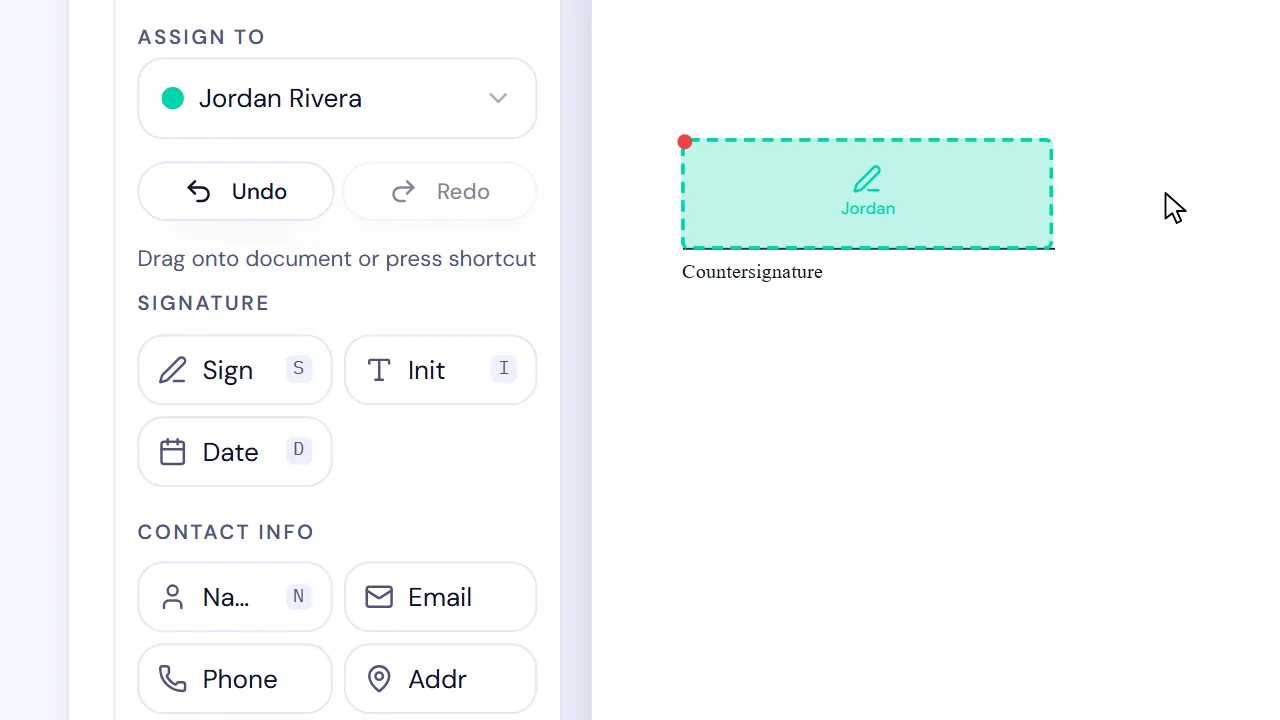
If you repeatedly use the same lawyer-approved NDA, you can turn the finalized PDF into a reusable SignQuick template so the field layout is preserved. Create a fresh version when the purpose, legal terms, or required signers change.
Create a free SignQuick account to test the workflow with a harmless sample. For the complete sender sequence, read how to get a client contract signed online.Can you sign an NDA electronically?
For covered U.S. transactions, 15 U.S.C. § 7001 generally says a contract or signature may not be denied legal effect solely because it is electronic. The same statute preserves other legal requirements and does not force a person to accept electronic records.
That is not a guarantee for every NDA. Authority to sign, consent, attribution, the final text, record retention, document type, governing law, and special formalities can affect the result. Rules outside the United States differ, so obtain local advice when the agreement warrants it.
Research sources
- USPTO: Trade secret policy
- WIPO Guide to Trade Secrets and Innovation: Basics of trade secret protection
- WIPO Guide to Trade Secrets and Innovation: Trade secret management
- 18 U.S.C. § 1833 — Exceptions to prohibitions
- 15 U.S.C. § 7001 — General rule of validity
Sources and live English and Spanish search results checked August 31, 2026. This article and template provide general educational information, not legal advice.
Frequently asked questions
Can I use this free NDA template for a freelance project?
Yes, as a general starting point. Replace every bracketed field, decide whether the agreement should be mutual or one-way, remove options that do not fit, and have a qualified local lawyer review higher-risk, regulated, cross-border, or unusually valuable disclosures.
Should a freelancer NDA be one-way or mutual?
Use a one-way NDA when only one party will disclose confidential information. Use a mutual NDA when both the freelancer and client may share non-public methods, pricing, customer information, product plans, or other sensitive material.
What information should an NDA cover?
Define the non-public information that actually matters to the relationship, such as source code, credentials, customer lists, pricing, financial data, product plans, research, or project materials. Also state the purpose for which the recipient may use it and the usual exclusions.
How long should an NDA last?
There is no universal term. Choose a period that fits the information, relationship, governing law, and business risk. Trade-secret treatment may depend on the information remaining secret and on reasonable protection measures, so get local advice instead of copying an arbitrary duration.
Does an NDA transfer ownership of freelance work?
No. An NDA controls the use and disclosure of confidential information. Put deliverables, payment, licenses, copyright assignments, portfolio rights, and ownership of work product in the services agreement or statement of work.
Can an NDA be signed electronically?
Often, yes, but the result depends on the transaction and applicable law. In the United States, federal law generally prevents covered contracts from being denied legal effect solely because an electronic signature or record was used. Other jurisdictions have their own rules and exceptions.
